Wireless fiber is a solution that provides cable-free network access using the interference-free and toll-free 60 GHz band. Operating in the 60 GHz band offers significant acceleration of wireless networks - with bandwidth in the gigabits!
Qualcom's first chips, which operate under the 802.11ay standard, offer speeds of 10 Gbit/s with minimal latency. The 60 GHz band is also used by devices that support 802.11ad, but they offer speeds of up to 5 Gbit/s.
Google (Free Space Optical Communication) is currently working on a wireless fiber using links based on the action of lasers. The aim of the project is to provide lightning-fast data transmission at low cost and without any cabling. The link is to offer 20 Gbps transfer rate. Wireless optical fiber would replace rather archaic communication solutions like radio lines. Huawei also has its own range of products for wireless fiber. One of them is smart antenna, providing access to the Internet via an external antenna integrated with the modem, which - after proper mounting and aiming - allows to reach very high speeds.
Speed and reliability of data transmission are of primary importance to an ever-growing group of users – especially in modern business. Fiber optic technology seemed to be the answer to the constantly increasing and dynamically changing telecommunications needs. In practice, however, it turned out that fiber optic internet has its weaknesses, which operators are somewhat reluctant to talk about. Fortunately, technological progress knows neither borders nor limits, so it did not take long for a new solution to appear on the market: wireless fiber. How does this revolutionary cable-free fiber technology work, and what benefits can users expect? We took a closer look!
What is wireless fiber?
Wireless fiber is a data transmission technology that uses light and does not require physical cables. Instead, it uses focused light or lasers to transmit a signal between two points. Although data is still transmitted using light, the need for wires is eliminated.

What is wireless fiber technology?
Wireless fiber is one of the biggest telecommunications innovations of recent years. AirFiber technology, provided by the Polish operator AirMAX, combines all the advantages of traditional fiber optics (i.e., very high bandwidth and minimal latency) with the flexibility, ease of installation, low failure rate, and strong aesthetic advantages of wireless solutions. AirFiber is based on fixed broadband link technology. Instead of standard fiber optic infrastructure, the operator uses innovative radio beam technology and the long-underestimated 60 GHz frequency band. The radio signal travels through it in a way analogous to a fiber optic cable. In this case, the role of cables is simply played by air. This happens because at high frequencies, total internal reflection occurs in the atmospheric gas. Thanks to the unique properties of molecular oxygen contained in the air, the problem of interference is completely eliminated. There is no need to lay physical cables to achieve maximum bandwidth, enabling the transmission of very large amounts of data over any distance at extremely high speed.
No cables means no key connectivity problems
Wireless fiber technology eliminates many limitations that have long been associated with traditional cable infrastructure. Instead of routing the signal through hundreds of meters of cables laid underground or on poles, transmission takes place wirelessly between transmitting and receiving points. As a result, users can enjoy very fast and stable internet without the need to build an expensive cable network.
Building a classic fiber optic infrastructure often requires excavation work, drilling, obtaining permits, and carrying out installation processes that can take from several days to even a few months. In rural, mountainous, forested areas or on the outskirts of cities, the cost of bringing a cable to a single building can be particularly high. Wireless fiber makes it possible to bypass these obstacles, allowing internet to be activated much faster and at significantly lower investment costs.
One of the biggest problems with traditional cable networks is infrastructure failure. Cables can be damaged by strong winds, heavy snowfall, frost, flooding, construction work, or animal activity. Even minor damage to a cable can result in a complete loss of internet access, and locating and repairing the fault often requires time and technical teams. For businesses, this means the risk of downtime, loss of contact with customers, and limitations in online operations. Wireless fiber eliminates the problem of cable damage because it does not use physical wires along the transmission path.
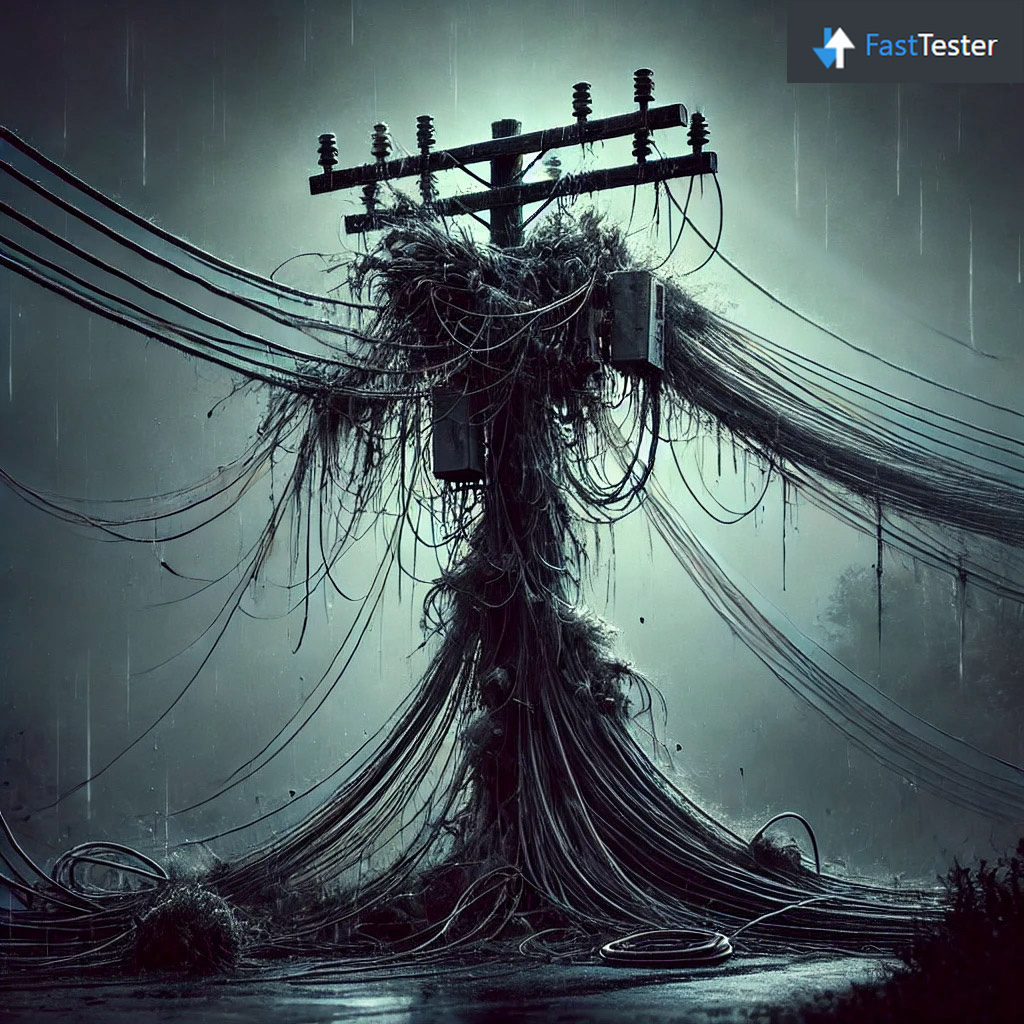
The lack of cable infrastructure also means greater resistance to external factors. There is no risk of line breaks caused by fallen trees, damage during excavation works, or fiber breaks due to mechanical stress. As a result, users can expect high service availability and stable connection parameters even under demanding operating conditions.
An important advantage of wireless fiber is also its environmental and aesthetic benefits. Building traditional networks requires intervention in the surroundings through excavation, installing poles, or running cables on building facades. In the case of AirFiber technology, there is no need to dig up the ground or install additional cables, which means the landscape remains unchanged and public space retains its aesthetic value. This is particularly important in tourist destinations, historic city centers, and environmentally valuable areas.
An additional benefit is the speed of service deployment. Installing wireless fiber does not require long-term excavation work or running cables through private property. As a result, internet access can be activated much faster than with traditional fiber infrastructure, and users receive a modern, high-performance connection without the inconvenience of network construction.
In practice, the absence of cables means fewer failures, shorter installation times, lower deployment costs, and greater flexibility in delivering high-speed internet in areas where traditional solutions are difficult or not cost-effective. This is why wireless fiber is increasingly becoming an alternative to classic cable networks.
|
❌ Problems of traditional cable fiber optic networks ❌ Need for excavation and drilling during installation ❌ High costs of building cable infrastructure ❌ Long implementation time for investments ❌ Fiber optic glass is fragile and prone to damage ❌ Risk of cable cuts during construction work ❌ Failures caused by excavators and construction machinery ❌ Cables can be torn down by fallen trees ❌ Cables may be damaged during storms and strong winds ❌ Load on cables caused by snow and ice ❌ Risk of damage due to frost and freezing of installations ❌ Risk of flooding of inspection chambers and telecom ducts ❌ Rodents may chew through cables ❌ Birds can damage overhead installations ❌ Tree roots can damage underground infrastructure ❌ Fiber optic is sensitive to bending and mechanical stress ❌ Every splice and connector can become a failure point ❌ Difficult location of cable damage ❌ Repairs may require excavation work ❌ Failures can cause hours or even days of internet downtime ❌ Network expansion requires laying additional cables ❌ Installation requires permissions from landowners and road authorities ❌ Excavation of private property, sidewalks, and roads ❌ Installation of boxes and cables on building facades ❌ Visible cables worsen the aesthetics of the area ❌ Cable infrastructure can spoil the landscape ❌ Network construction may negatively impact the natural environment ❌ Bringing fiber to mountainous and forested areas is expensive ❌ Building fiber for single buildings is not cost-effective ❌ Every cable failure requires technical intervention |
✅ How AirFiber wireless fiber solves these problems ✅ Installation without digging or disturbing the terrain ✅ Significantly lower deployment costs, especially over long distances ✅ Fast service activation ✅ No glass cables along the transmission path ✅ No cables that can be cut ✅ Transmission takes place without excavation or wires ✅ No wires suspended between poles ✅ Resistance to problems associated with cable infrastructure ✅ No cables exposed to physical loads ✅ No underground or overhead cables requiring protection ✅ No underground infrastructure ✅ No cables that can be targeted by animals ✅ No suspended wire networks ✅ No buried cables in the ground ✅ No issues caused by mechanical cable damage ✅ Fewer infrastructure elements requiring maintenance ✅ No outages caused by cable breaks ✅ No costly excavation work during repairs ✅ High service availability thanks to elimination of cable-related issues ✅ Easier and faster network expansion ✅ Significantly fewer formal requirements during deployment ✅ Preservation of existing infrastructure and surfaces ✅ Minimal impact on building appearance ✅ No hanging wires ✅ Preservation of aesthetic value of space ✅ Reduced environmental impact ✅ Ideal solution for challenging locations ✅ Ability to quickly connect remote locations ✅ Elimination of the most common cause of failures – cable damage |
There are many more benefits for users
The AirFiber wireless fiber provided by AirMAX has introduced a completely new quality of communication on the Polish market. The solution is designed for companies that require truly high bandwidth. It provides an extremely fast and stable connection. Users can expect speeds of up to approximately 15 Gbps! Thanks to the use of advanced wireless technology and continuous network monitoring, AirFiber is characterized by very low failure rates. Another advantage of the service is low latency in data transmission. This is particularly important for businesses and gamers. Its wide coverage allows the solution to be quickly and effectively deployed in many locations, including areas where other fiber operators (and not only them) are unable to provide a stable connection. Service activation takes place within a maximum of 48 hours from the moment the order is placed. The AirMAX operator offers a variety of packages and subscription plans, allowing the service to be tailored to individual needs. Customers receive 24/7 access to technical support, providing immediate assistance in resolving potential issues. In B2B relationships, an SLA agreement is signed, guaranteeing consistent internet parameters and a strict response time to reported issues throughout the entire service period. Before signing the contract, customers can take advantage of a free trial period at their home or business premises to see how AirFiber performs under real operating conditions. They do not have to “blindly” rely on the operator’s promises and marketing claims. All of this translates into a level of trust and security that is rarely seen in the telecommunications industry.
In a head-to-head comparison with traditional fiber optic internet, AirFiber wireless fiber appears to be the clear winner.